
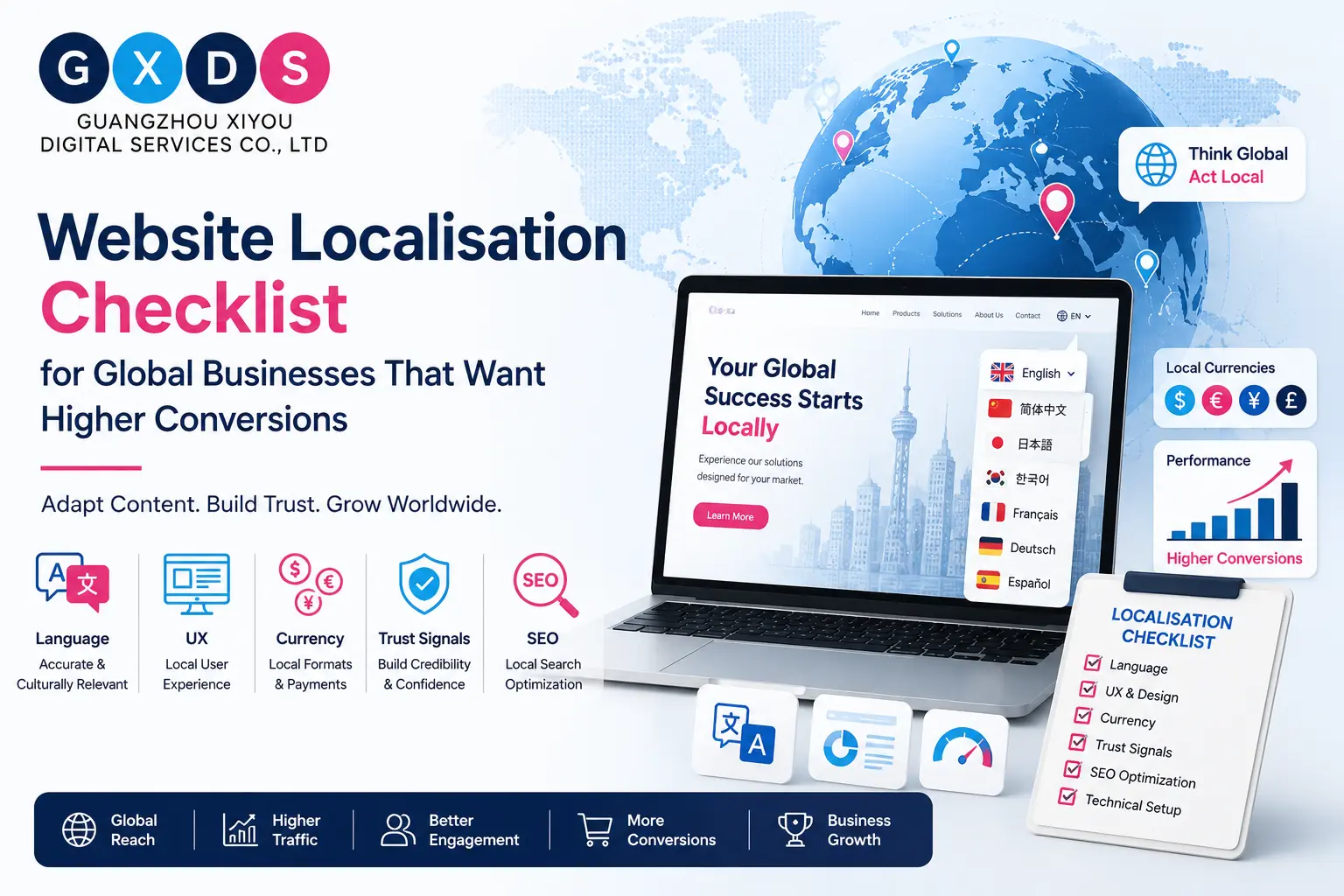
Global expansion requires more than just translating. It demands website localisation services to align your website’s content with technological, cultural and consumer expectations across different markets.
What Website Localisation Means Beyond Translation
The process of localizing websites extends far beyond just translating words from one language into another. It is about adapting your complete online presence to appeal to people in your local area. The most effective website localisation services incorporate cultural specifics and preferences for design, as well as local laws, and users’ behavior.
A product website that is targeted at Chinese consumers might need various visuals, payment methods as well as messaging than an European customer.
Read More : International SEO Strategy for Expanding Across Asian Markets in 2026
Why Localised Websites Convert Better
Localized sites perform better as they establish trust and minimize friction. If users are exposed to familiar languages as well as currency or the content relevant to them they are more likely to become engaged and even convert.
Firms that invest into website localisation services typically check:
- Conversion rates that are higher
- Lower bounce rates
- Increased trust in the customer
- Brand credibility is strengthened in the new markets
Complete Website Localisation Checklist
The success of a localisation strategy extends beyond translation, and involves adjusting all aspects of your site to the local audience. This checklist outlines the most important factors that can improve the user experience, establish trust and boost conversions in the global market.
Language
Be sure to ensure a precise translation, incorporating the correct translation and cultural amplification. Do not use direct translations. Instead, focus on the context, tone and the intent.
UX
Experiences for users should be based on your local habits of browsing. The styles of navigation, colors and expectations for layouts are different across countries.
Currency
The display of local currency, prices and currencies is in formats. This helps to eliminate confusion and increases confidence at checkout.
Trust Signals
Use regionally specific testimonials, accreditations and payment options in order to boost credibility.
SEO
Optimize your website for local search engines, such as Baidu for China or Google worldwide. Strong website localisation services always include localized keyword strategies.
Technical Elements Required for Global Websites
The technical readiness of your website is crucial to the success of localisation. Your site should be able to support several languages, high loading speeds and local hosting.
Important elements include:
- Tags for Hreflang to target language
- Mobile optimization to support global users
- Local hosting, or CDN to increase speed
- Conformity to regional rules
In the absence of these factors, even the top website localisation services could not deliver the desired results.
SEO Optimisation for Localised Websites
Localized SEO makes sure that your content appears in various regions. This includes keyword research tailored to the market in question and meta tags that are localized as well as content that is culturally relevant.
In particular, Chinese users rely heavily on Baidu for their search results, and this needs a totally distinct SEO method than Google. Proficient website localisation services will ensure that your content is easily found to every market you want to target.
Localisation Mistakes That Cost Sales
Businesses lose customers because of common errors in localisation:
- Automated translations with no any review
- Ignoring cultural differences
- Inability to adapt payment methods
- Mobile optimization is not optimal.
- Branding inconsistent across different regions
Beware of these mistakes for maximising the benefits for the website localisation services.
How to Launch Localised Pages Faster
The speed of your expansion is crucial in the global market. For faster launch:
- The most popular pages should be prioritized.
- Utilize CMS platforms that are scalable CMS platforms
- Set up the translation management system
- Get localisation assistance from experienced teams.
A well-planned approach allows businesses to implement website localisation services effectively, without losing quality.
Measuring Website Localisation ROI
The ability to track performance is vitally important in order for evaluating your success. Important metrics include:
- Regional rates of conversion
- The growth of local market traffic
- Measures of engagement (time on the page or bounce rate)
- The revenue generated from localized pages
Companies who make investments into website localisation services must continuously review data in order to develop strategies, and enhance the results.
Xiyou Website Localisation Process
A planned localisation process will ensure the same outcomes. This typically consists of:
- Research on the market and analysis of audience
- Translation and adaptation of content
- Implementation of technical aspects
- SEO optimization on localized platforms
- Continuous performance tracking
This method ensures that localization isn’t just a once-in-a-while job, but rather an ongoing plan.
Conclusion
Investing in website localisation services is vital for any business looking to expand globally and attain greater conversion rates. By using the correct strategy, the right tools and knowledge, organizations are able to effectively reach out to diverse users and sustain expansion. By partnering with an experienced agency such as Guangzhou Xiyou Digital Services ensures an effective localisation plan that is backed by information, experience in the marketplace, as well as an eye for the future.
FAQs
1.What exactly is website localisation?
Website localisation is the process of adjusting the content, layout and function to fit an audience or region.
2.What is the difference between localisation and translation?
Translators focus on only speaking, while localisation encompasses technical, cultural, as well as adapting user experiences.
3.Does localisation improve conversions?
Localized sites can build confidence and increase the conversion rate.
4.Do I need to localise the entire site?
But not always. Begin with the most important pages, such as the homepage, product pages as well as landing pages.
5.Which web pages must be relocalised in the first place?
Pages with high traffic and high conversion should be given the top priority.
6.Does localisation help SEO performance?
Yes, it enhances the rankings for local search engine results as well as increases the amount of organic traffic.
7.What languages should I have?
The answer is dependent on your targeted areas of business and the goals you have set for yourself.
8.How can I avoid common mistakes in localisation?
Poor translation, not paying attention to the culture and the absence of any technological optimization.
9.How long will the process of locating websites require?
The time frame varies depending on the website’s dimensions and the complexity of the site, usually it takes between one and two weeks.
10.How much do localisation services cost?
Costs are based on extent, the language used, and the technical specifications.