
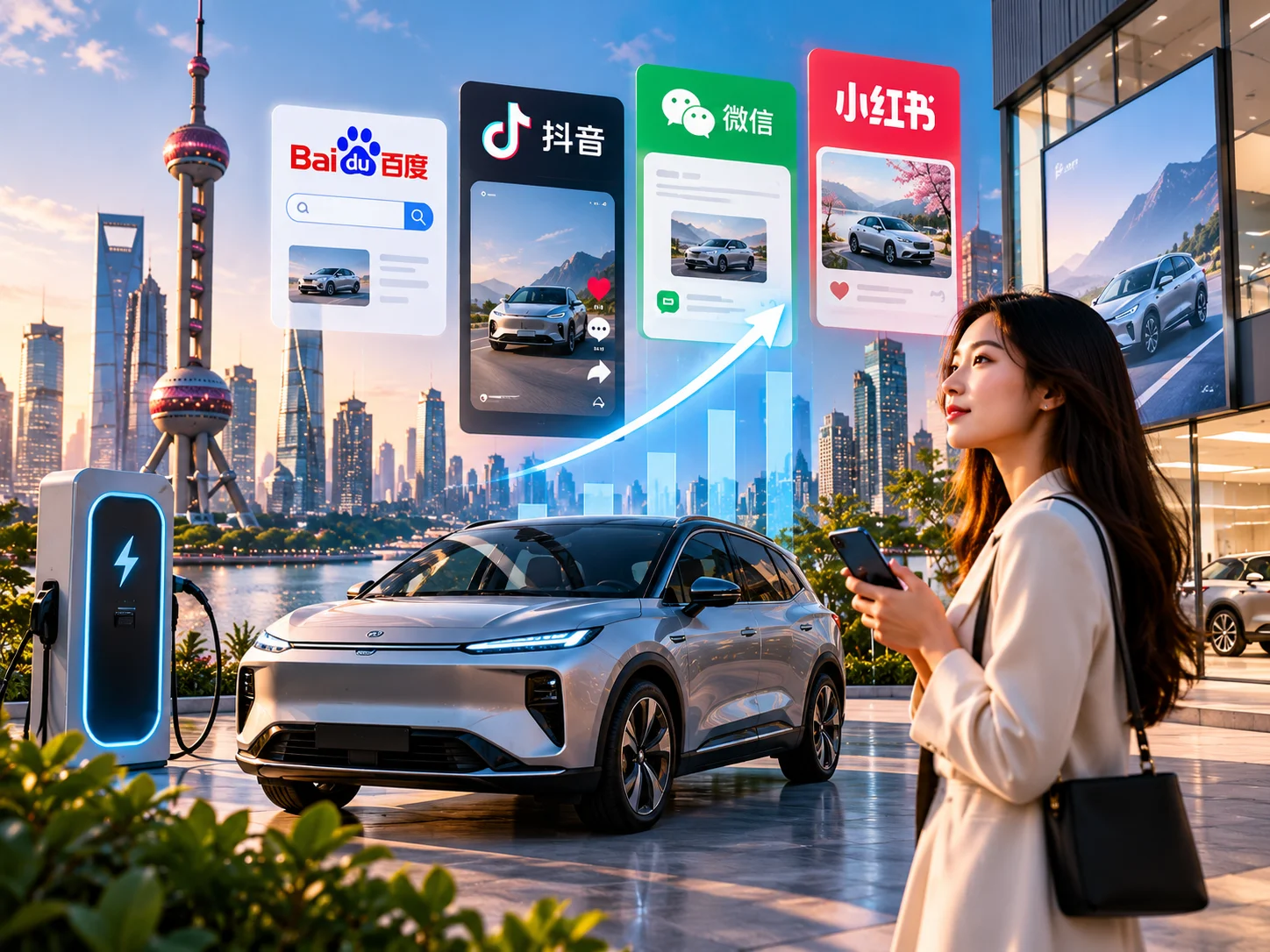
Selling electric vehicles in China is not only a product challenge. It is also a visibility, trust and customer-journey challenge. Buyers research specifications, compare brands, watch demonstrations, read community discussions and look for proof that a company understands their needs before they enquire, visit a showroom or book a test drive.
For EV & Electric Vehicle Companies, digital marketing needs to connect each of those moments. A strong plan should make the brand easy to find on Chinese search platforms, active on the social channels people actually use, useful during product research and simple to contact when buying intent rises.
That means relying on local platforms rather than copying a Google-first strategy from another country. Baidu, WeChat, Douyin and Xiaohongshu all play different roles in China’s digital ecosystem, while locally adapted websites, Chinese-language content and compliant digital operations support the full customer journey.
Start With the Way Chinese EV Buyers Research
An electric vehicle is a high-consideration purchase. Most buyers need more than one advert before they act. They may search for a model category, watch a driving video, compare range or charging information, read comments about ownership and then return later through search or social media.
This makes customer-journey planning central to EV marketing. A campaign should account for different levels of intent instead of treating every visitor as someone who is prepared to buy immediately.
At the awareness stage, useful content can introduce the vehicle, use case or technology. During consideration, people need clearer detail about features, ownership, charging, servicing, safety information, model differences and practical suitability. At the action stage, the path to a test drive, dealer contact or sales enquiry should be short and obvious.
Build Search Visibility on Baidu Around Real Buying Questions
Search can capture people who are already looking for information. The company website states that Baidu is a major part of search behaviour in China and that local SEO should account for Chinese-language content, technical optimisation and the local digital environment.
For EV & Electric Vehicle Companies, that creates an opportunity to build pages around specific customer questions rather than relying mainly on broad brand terms.
Useful search themes can include vehicle type, city use, family use, charging needs, ownership questions, model comparisons, after-sales information and dealership-related searches. A person searching a precise question often has a different level of intent from someone who has only seen a short video.
An effective Baidu SEO plan should therefore include:
- Clear Chinese-language landing pages for individual models and buyer needs.
- Search-friendly pages for common questions about charging, range, maintenance and ownership.
- Internal links that guide readers from educational content to model pages.
- Accurate titles, headings and page descriptions that match search intent.
- Fast, mobile-friendly pages that make key information easy to scan.
Use Paid Search to Capture High-Intent Demand
SEO and paid search can support each other. Organic pages build long-term visibility, while paid campaigns can put a relevant offer in front of people searching for a model type, a test drive or other high-intent terms.
Good EV marketing on search should separate campaigns by intent. A broad awareness keyword should not use the same advert, landing page or bid logic as a search that clearly signals interest in a dealership visit.
For example, an educational search could lead to a detailed guide about charging or ownership. A high-intent search should lead to a focused page with model information, a location or dealer path and a simple enquiry action.
Use Douyin for Product Demonstration, Not Just Reach
Electric vehicles are highly visual products. Short-form video gives brands a practical way to show the vehicle in motion, explain features and answer questions that are difficult to communicate through static adverts.
The company website lists Douyin among the important local social channels for brands operating in China, alongside WeChat, Weibo and Xiaohongshu.
For an EV brand, Douyin content can focus on real product understanding. Useful formats may include:
Show Everyday Driving Situations
Film parking, city driving, luggage space, rear-seat use, charging steps, dashboard functions and other situations buyers can recognise.
Explain One Feature at a Time
Short videos are easier to follow when each clip has one clear subject. A single video can explain a charging feature, interior control, driver-assistance function or cabin detail without trying to cover the whole car.
Answer Common Comments
Questions under videos can become content topics. This creates a feedback loop between the audience and the content team and helps the brand address genuine concerns in plain language.
Build Trust and Ongoing Contact Through WeChat
Many EV buyers need repeated contact before taking action. WeChat can support that longer relationship by giving the brand a place to publish information, share updates and maintain communication with interested users.
A practical WeChat plan can include detailed product articles, model updates, ownership guidance, event information, service content and links to enquiry or test-drive pages. The platform can also help connect campaign traffic with a more persistent brand relationship after the first click.
This matters because not every person reached by EV marketing will act in the same session. Some will need several interactions before they speak to sales.
Content should therefore avoid constant sales pressure. A better mix answers questions, explains the product, supports owners and provides clear action points when the reader wants to move forward.
Use Xiaohongshu to Support Research and Social Proof
People researching a vehicle often want practical, experience-led information. Xiaohongshu can support this stage because content can be framed around real questions, use cases and lifestyle considerations.
Instead of publishing only polished promotional images, EV brands can develop posts around topics such as commuting, family space, charging routines, interior details, road-trip planning or everyday ownership.
For EV & Electric Vehicle Companies, the value of Xiaohongshu is strongest when social content and search content reinforce each other. A concern that appears repeatedly in social discussions can become a longer website guide. A detailed guide can then provide material for several shorter social posts.
Localise the Message, Not Only the Language
Direct translation is rarely enough for a market with different platforms, search habits, content formats and customer expectations. The company website describes localisation as adapting language, tone, visuals, platforms and timing to Chinese audiences.
For an EV brand, localisation should reach product communication too. The same vehicle feature may matter for different reasons depending on city conditions, family needs, parking situations, commuting patterns or charging access.
A localised page should therefore answer the questions relevant to the intended audience rather than merely translating copy from a global website.
Create a China-Focused Website That Supports Conversion
A marketing campaign cannot perform well if the destination page is slow, confusing or poorly adapted to local users. The company’s service information emphasises mobile-friendly web development, local compliance, hosting considerations and support around ICP requirements.
A China-focused EV website should make core actions easy to complete on mobile. Visitors should be able to find model details, compare relevant information, locate dealers or service points where applicable, and submit an enquiry without navigating through unnecessary pages.
Important conversion pages may include:
- Model-specific landing pages.
- Test-drive enquiry pages.
- Dealer or location information.
- Charging and ownership guidance.
- Frequently asked questions.
- Contact options suited to local users.
Build Content Around Questions That Block the Sale
Content should reduce uncertainty. Before producing another brand story or corporate update, marketing teams should ask what information is stopping a potential customer from moving closer to purchase.
For an EV audience, those questions may concern charging, daily usability, maintenance, technology, space, service access or differences between models.
A useful content plan can divide topics into four groups: education, comparison, ownership and action. Educational pieces explain concepts. Comparison content helps readers understand meaningful differences. Ownership content addresses life after purchase. Action pages make it easy to book, enquire or visit.
This structure gives EV marketing a clearer commercial purpose without turning every article into an advert.
Connect Online Interest With Dealers and Test Drives
Digital activity should not stop at clicks or form submissions. For vehicle companies, the real value often comes from what happens after a lead reaches the sales network.
Marketing and sales teams need a shared process for lead handling. Enquiries should carry enough context to help the next conversation. Source, model interest, campaign, location and requested action can all help sales teams respond more appropriately.
This is where EV & Electric Vehicle Companies can improve efficiency without simply increasing advertising spend. Better routing, clearer lead information and more relevant follow-up can help the existing demand move through the sales process with less friction.
Use Retargeting Without Repeating the Same Advert
Many interested users will leave before taking action. Retargeting can bring them back, but repetition quickly becomes wasteful if every person sees the same message.
Audience groups should reflect behaviour. Someone who watched a product video may need a deeper feature message. Someone who visited a model page may respond better to comparison information. Someone who reached a test-drive page but did not submit may need a simpler reminder.
Measure the Steps That Lead to Customer Acquisition
Clicks, views and follower growth can help diagnose campaign performance, but they are not enough on their own. EV brands need to connect media activity with actions that indicate stronger buying intent.
Useful measurement points may include model-page visits, engaged sessions, brochure or specification views, dealer-location visits, enquiry starts, completed forms and test-drive requests.
The company describes its approach as using platform insights, audience behaviour, campaign optimisation, reporting and ROI measurement across search, social, content and e-commerce activity.
Keep SEO, Social, Paid Media and Content Working Together
A fragmented channel plan makes customer acquisition harder. Search teams may target one message, social teams another and paid campaigns a third. Buyers then receive an inconsistent view of the brand.
A stronger system begins with shared customer questions and business goals. SEO can capture active demand. Social content can create familiarity and explain products. Paid media can increase reach and recapture interested users. Website content can provide depth. CRM and dealer processes can carry the enquiry into sales.
GUANGZHOU XIYOU DIGITAL SERVICES CO. LTD presents its China-focused services across SEO, PPC advertising, content marketing, social media, web development, lead generation and local digital compliance support. For an EV brand, the practical lesson is that customer acquisition improves when these functions share data and work towards the same conversion path.
Common Digital Marketing Mistakes EV Brands Should Avoid
One mistake is copying an international channel plan into China without adapting platforms or content. Another is sending all traffic to a generic homepage. Brands also lose efficiency when they focus on reach while leaving product questions unanswered.
Other problems include weak mobile landing pages, inconsistent Chinese-language terminology, slow lead follow-up and social content that looks attractive but provides little useful information.
A Practical Digital Marketing Framework for EV Customer Growth in China
A workable plan can begin with five connected priorities.
First, build search coverage for the questions and high-intent terms buyers use. Second, create useful video and social content around real vehicle use. Third, make the website fast, localised and easy to act on. Fourth, connect media leads with an organised sales or dealer process. Fifth, review performance data and improve weak stages instead of increasing budget automatically.
This gives marketing teams a repeatable system rather than a collection of unrelated campaigns.
GUANGZHOU XIYOU DIGITAL SERVICES CO. LTD also highlights market research, competitor analysis, localisation, campaign management and reporting as parts of its China-focused digital work. Those areas are particularly relevant when a vehicle brand needs to understand local demand before scaling media activity.
FAQs
1.Which digital platforms matter most for EV companies in China?
Baidu can support search visibility, while WeChat, Douyin and Xiaohongshu can support content, engagement and ongoing customer contact. The right mix depends on the audience, campaign goal and stage of the buying journey.
2.How can Baidu SEO help an EV brand generate customers?
Baidu SEO can help a brand appear for model, ownership, charging and comparison-related searches. Strong pages should answer the search clearly, provide useful product information and guide interested visitors towards the next relevant action.
3.What type of content works well for electric vehicle marketing?
Useful content often explains real product use, features, charging, ownership, model differences, service information and common buyer questions. Short video can show practical situations, while website and WeChat content can provide more detail.
4.Should an EV company use paid advertising and SEO together?
Yes. Paid campaigns can support faster visibility and testing, while SEO can build longer-term search coverage. Search-term and campaign data can also reveal topics that deserve stronger organic content.
5.How should EV brands measure digital marketing performance?
They should look beyond impressions and clicks. Model-page engagement, enquiry starts, completed leads, dealer interactions and test-drive requests give a clearer view of whether digital activity is moving people towards purchase.
Turning Digital Attention Into More EV Customers
Winning more customers in China requires more than running adverts on several platforms. The full journey needs to make sense: people must be able to find the brand, understand the vehicle, trust the information, return for deeper research and take action without unnecessary friction.
For EV & Electric Vehicle Companies, the strongest approach connects Baidu search visibility, Chinese social channels, useful content, locally adapted landing pages, paid campaigns and organised lead handling. EV marketing then becomes a customer-acquisition system rather than a set of isolated posts and adverts.
GUANGZHOU XIYOU DIGITAL SERVICES CO. LTD works across the China-focused services that support that system, including SEO, PPC, social media, content, web development and lead generation. The core priority remains simple: make every digital touchpoint useful enough to move the buyer one step closer to a real sales conversation.