
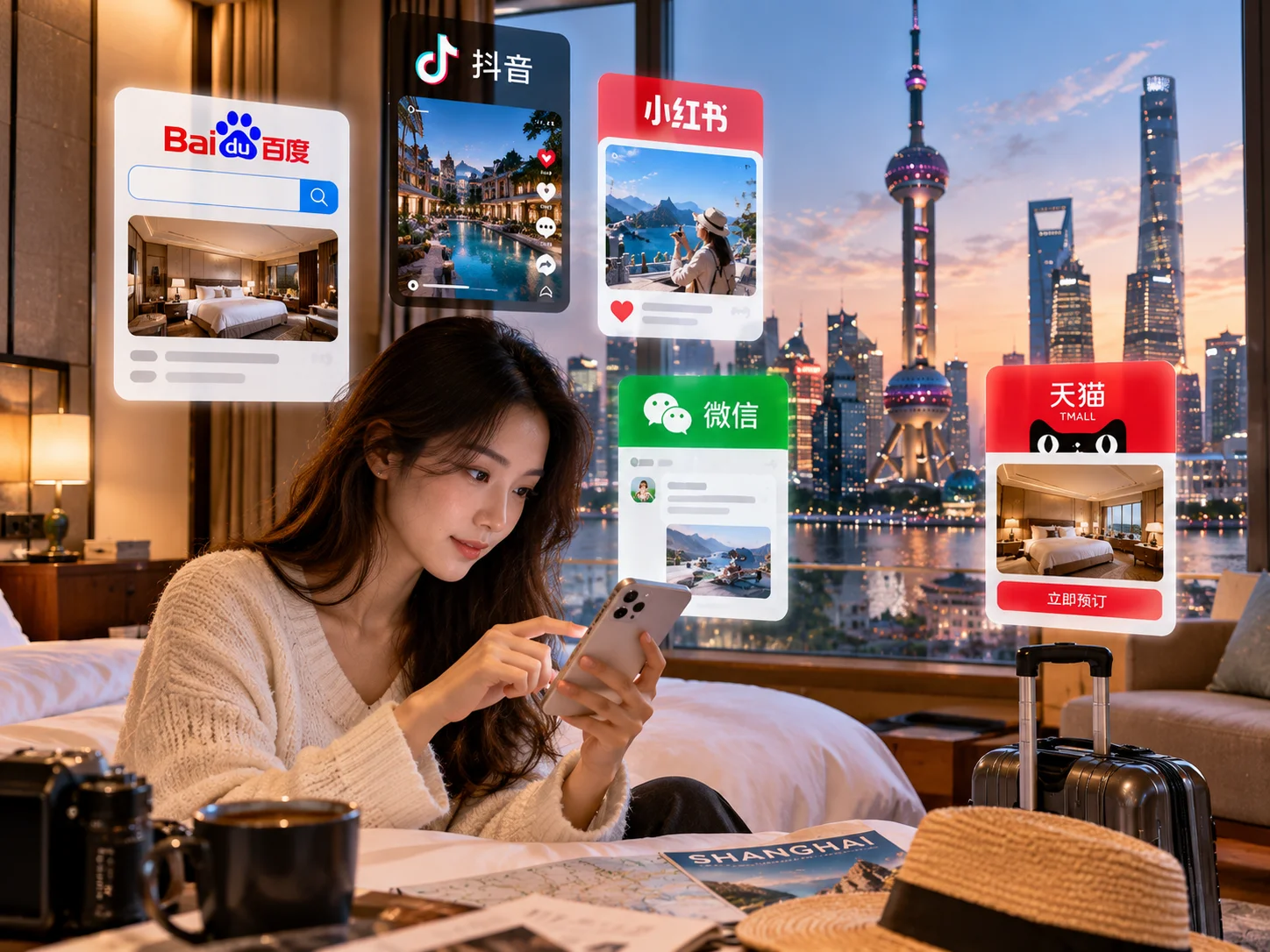
Selling to Chinese customers is not simply a matter of translating an existing product page into Mandarin and running the same campaign used in other markets. The customer journey often happens across a different mix of search, social, content and ecommerce platforms, with trust built long before a shopper reaches the checkout.
For ecommerce brands, the practical question is how to reduce that gap between interest and purchase. That means making the brand easy to find, easy to understand and easy to trust on the channels Chinese customers already use. Although this article focuses on ecommerce, many of the same principles also apply to Hotels & Hospitality businesses selling rooms, packages and experiences to Chinese travellers.
GUANGZHOU XIYOU DIGITAL SERVICES CO. LTD describes China’s digital ecosystem as being built around local platforms including Baidu, WeChat, Weibo, Douyin, Xiaohongshu, Tmall and JD. Its website also notes that Chinese consumers are mobile-first, socially influenced and trust-driven.
That changes the sales strategy. A strong ecommerce plan for China needs to connect product visibility, local content, social proof, store experience and conversion activity rather than treating each channel as a separate task.
Start With the Chinese Customer Journey, Not the Product Catalogue
A common mistake is to begin with the catalogue: translate product titles, upload images and start spending on traffic. That skips the part where a customer decides whether the brand feels relevant and credible.
A better starting point is the full journey:
- Where does the customer first hear about the product?
- What do they search before buying?
- Which reviews or creators influence them?
- What information do they need before buying from an overseas brand?
These questions help the business map content to real buying behaviour.
The first touchpoint may be a Douyin video, Xiaohongshu review, Baidu result, WeChat recommendation or a listing on Tmall or JD. The platform should follow the customer journey.
This principle also matters in hotel marketing. A guest researching a stay may compare location, room quality, dining, reviews and nearby experiences before making a booking. Ecommerce customers follow a similar pattern when they compare product quality, proof, value, delivery and after-sales support.
Localise the Buying Experience Beyond Language
Translation helps customers understand words. Localisation helps them understand the brand.
A page can be grammatically correct and still feel unfamiliar. Product names, tone, visuals, sizing, FAQs and service expectations may need adjustment.
GUANGZHOU XIYOU DIGITAL SERVICES CO. LTD states that direct translation can miss cultural context and that effective Chinese content needs to reflect local preferences, platform behaviour and customer journeys.
For ecommerce stores, localisation should cover the parts that affect a buying decision most:
- Clear product titles and useful descriptions
- Images that answer practical questions
- Local measurements where relevant
- Delivery, return and support information
- Mandarin customer-facing content where required
- Mobile layouts that make comparison simple
- Trust signals close to the point of purchase
Website localisation is also more than replacing text. The company’s own guidance notes that a site aimed at Chinese customers may need different visuals, payment methods and messaging than one aimed at a European audience.
The goal is simple: remove avoidable uncertainty.
Build Visibility Across Search, Social and Ecommerce Platforms
Chinese customers may encounter a brand several times before purchasing, so single-channel thinking is risky.
The Xiyou website lists Baidu, WeChat, Weibo, Douyin, Xiaohongshu, Tmall and JD among the main parts of the local digital ecosystem. It also positions search, social media and ecommerce as connected areas rather than isolated services.
Each channel can play a different role.
Baidu for Intent and Brand Checking
Search becomes important when customers want details, comparisons, reviews or reassurance. Useful pages should answer the questions a buyer is likely to type before spending money.
Strong search visibility also gives customers another place to verify the business after seeing it on social media.
Xiaohongshu for Product Research and Social Proof
Xiaohongshu works well for visual products and experience-led content. The Xiyou content marketing page describes the platform as useful for lifestyle content, user-friendly reviews and trust-building material.
Instead of posting only polished campaign images, ecommerce brands can use:
- Product demonstrations
- Real use cases
- Comparison content
- Customer questions
- User reviews
- Care tips
- Styling or application ideas
- “What to expect” content
The closer the content is to a real customer question, the more useful it becomes during consideration.
Douyin for Demonstration and Short-Form Demand
Some products need to be seen in action. Short video can show size, texture, speed, movement, assembly, application or before-and-after context faster than a written description.
The strongest videos make one point clearly: answer a question, show a feature or remove a doubt, then make the next step obvious.
WeChat for Ongoing Customer Relationships
WeChat combines messaging, content, payments and mini-programmes within one ecosystem. Xiyou’s WeChat guide explains that it can support customer service, ecommerce and content marketing at the same time.
That makes it useful after the first interaction. Customers can stay connected to the brand, receive updates, ask questions and move towards purchase without restarting the relationship on another channel.
Use Social Proof to Reduce Purchase Risk
For an unfamiliar ecommerce brand, trust is often the real conversion problem.
The customer may still hesitate over quality, shipping, legitimacy, fit or post-purchase support. Brand claims alone may not solve that.
Content from actual users can make the decision feel less risky. Product reviews, demonstrations, buyer feedback and creator-led examples give customers evidence they can evaluate.
Xiyou’s article on KOC marketing describes Key Opinion Consumers as everyday users who share product experiences rather than large-scale celebrity endorsements. The article argues that this type of content can help reduce perceived risk and build trust.
A smaller library of useful, credible customer content can already support sales pages, social feeds and retargeting. For Hotels & Hospitality, the equivalent may be guest experiences, room walk-throughs and practical travel information; ecommerce can use the same logic through real product use and customer proof.
Improve Product Pages for Chinese Customers
Traffic does not create sales if the page leaves basic questions unanswered.
A useful product page should help the customer decide without hunting for essential details. It should cover what the item is, how it is used, key specifications, fulfilment and after-sales expectations.
Images also need a job. One can show scale, another a feature, packaging or use. Ecommerce teams can borrow a useful lesson from hotel marketing: product pages should give enough decision support before purchase.
Avoid hiding important details below long promotional copy. The customer should not have to scroll through slogans to find dimensions, material, delivery information or support terms.
Connect Content Directly to Commercial Intent
Content can attract attention without producing sales if it stops at awareness.
Every major content theme should have a commercial role. A comparison article can lead to a relevant category. A product demo can link to the exact item shown. A care guide can support an accessory. A customer review can reinforce the product page.
The path should feel natural, not aggressive.
Match content to buyer stage. Early content can answer broad questions; consideration content should focus on comparisons, use cases and proof. Near purchase, remove friction around delivery, returns and support. After purchase, provide care and setup material that can encourage repeat business.
This connected approach is especially useful in Hotels & Hospitality, where hotel marketing must often link destination interest, property information, offers and booking pages. Ecommerce brands can use the same principle by connecting search, social content and product pages around one clear journey.
Combine Organic Visibility With Paid Campaigns
Organic content supports trust and long-term visibility. Paid campaigns can speed up testing and bring qualified users into the funnel.
The key is not to run paid media in isolation.
If a brand sends paid traffic to a weak page with little proof and poor localisation, more traffic can simply mean more wasted spend. Paid campaigns work better when the store, content and tracking are already strong enough to support conversion.
The Xiyou website says its China-focused PPC work spans platforms such as Baidu, WeChat and Douyin, while its ecommerce support covers store optimisation, campaign planning and cross-border growth activity.
Start with a specific commercial objective. That may be product-page visits, add-to-cart actions, qualified enquiries, first purchases or repeat orders. Then build the campaign around that goal.
Creative testing should focus on meaningful differences such as problem-led, demonstration-led, proof-led and offer-led messaging. Avoid changing many variables at once.
Make Mobile Buying Simple
A mobile-first audience will notice friction quickly.
Slow pages, tiny text, crowded menus, unclear buttons and long forms all make the purchase harder. A good mobile experience should help a user understand the product and act with minimal effort.
Keep key information close to the main purchase area, make galleries easy to swipe and reduce unnecessary form fields.
The same principle matters in hotel marketing, where a mobile user may move from social content to a room page and then to booking in a short session. Ecommerce brands should assume the customer may move just as quickly from a product video to a purchase page.
Use Data to Find Where Sales Are Being Lost
More traffic is not always the answer.
If product views are rising but add-to-cart actions are weak, the issue may be price perception, product clarity or trust.
If add-to-cart activity is healthy but checkout completion is low, the issue may sit in shipping, payment, fees, form friction or policy clarity.
If paid traffic converts but organic traffic does not, the audience intent or landing pages may be different.
Track the main commercial steps: product views, add-to-cart rate, checkout starts, purchases, repeat orders, returns, customer questions and performance by traffic source.
The point is to identify where a customer drops out and fix that stage first.
Avoid the Most Common Mistakes
International ecommerce brands often lose sales in China for avoidable reasons.
One is copying a global campaign without local context. Another is relying on translation while ignoring customer expectations. Some brands enter too many platforms at once and maintain none of them well. Others spend on traffic before fixing the store.
Inconsistent brand information across channels can also reduce confidence. Chinese social platforms should not be treated only as awareness channels; content, community, search and commerce can sit close together.
For Hotels & Hospitality and ecommerce alike, trust can be damaged by small inconsistencies. Clear information, useful content and a stable brand experience matter more than constant posting.
A Practical Sales Framework for Ecommerce Brands
A focused China sales strategy can follow six connected stages.
First, define the customer segment and the product problem being solved.
Second, localise the product pages and core sales material.
Third, build search and social visibility on the channels that match the customer journey.
Fourth, add credible customer proof through reviews, demonstrations and user-led content.
Fifth, use paid media to test audiences and commercial messages once the conversion path is strong.
Sixth, track where customers drop out and improve that step before increasing spend.
The aim is to keep the team centred on revenue rather than activity.
FAQs
Do ecommerce brands need Chinese social media to sell to Chinese customers?
Not in every case. Chinese customers outside mainland China may also be reached through international channels such as Google, YouTube, Facebook, Instagram and TikTok, while WeChat and Xiaohongshu can still support Chinese-language engagement. Xiyou’s guidance covers both local Chinese platforms and international channels for overseas Chinese audiences.
Is translating an ecommerce website into Mandarin enough?
No. Translation handles language, but localisation also considers imagery, product presentation, cultural context, customer expectations, mobile use, payment experience and service information.
Which Chinese platforms matter most for ecommerce?
It depends on the product and customer journey. Baidu can support search visibility, Xiaohongshu can support research and social proof, Douyin can show products through short video, WeChat can support ongoing engagement, while Tmall and JD are major ecommerce platforms.
Can content marketing directly support ecommerce sales?
Yes, when content is connected to buyer intent. Product comparisons, demonstrations, FAQs, reviews and care content can help customers move from research to purchase.
What can ecommerce brands learn from Hotels & Hospitality marketing?
Both sectors depend heavily on reducing uncertainty before purchase. Strong hotel marketing gives customers enough information to assess the stay before booking. Ecommerce should do the same for the product through clear details, strong visuals, proof and simple purchase steps.
Turn Chinese Customer Interest Into Measurable Sales
Getting more sales from Chinese customers requires more than adding another advertising channel. Ecommerce brands need a connected system that brings together localisation, search visibility, social proof, platform-specific content, useful product pages, paid acquisition and conversion analysis.
Start with the customer journey. Find where people meet the brand, what they need before buying and which parts of the store create hesitation. Strengthen those points one by one.
The same principle that supports Hotels & Hospitality businesses also applies to online retail: give customers enough relevant information and trust to make a confident purchase. When content, platforms and store experience support the same decision, more of the traffic you already generate has a chance to become revenue.