
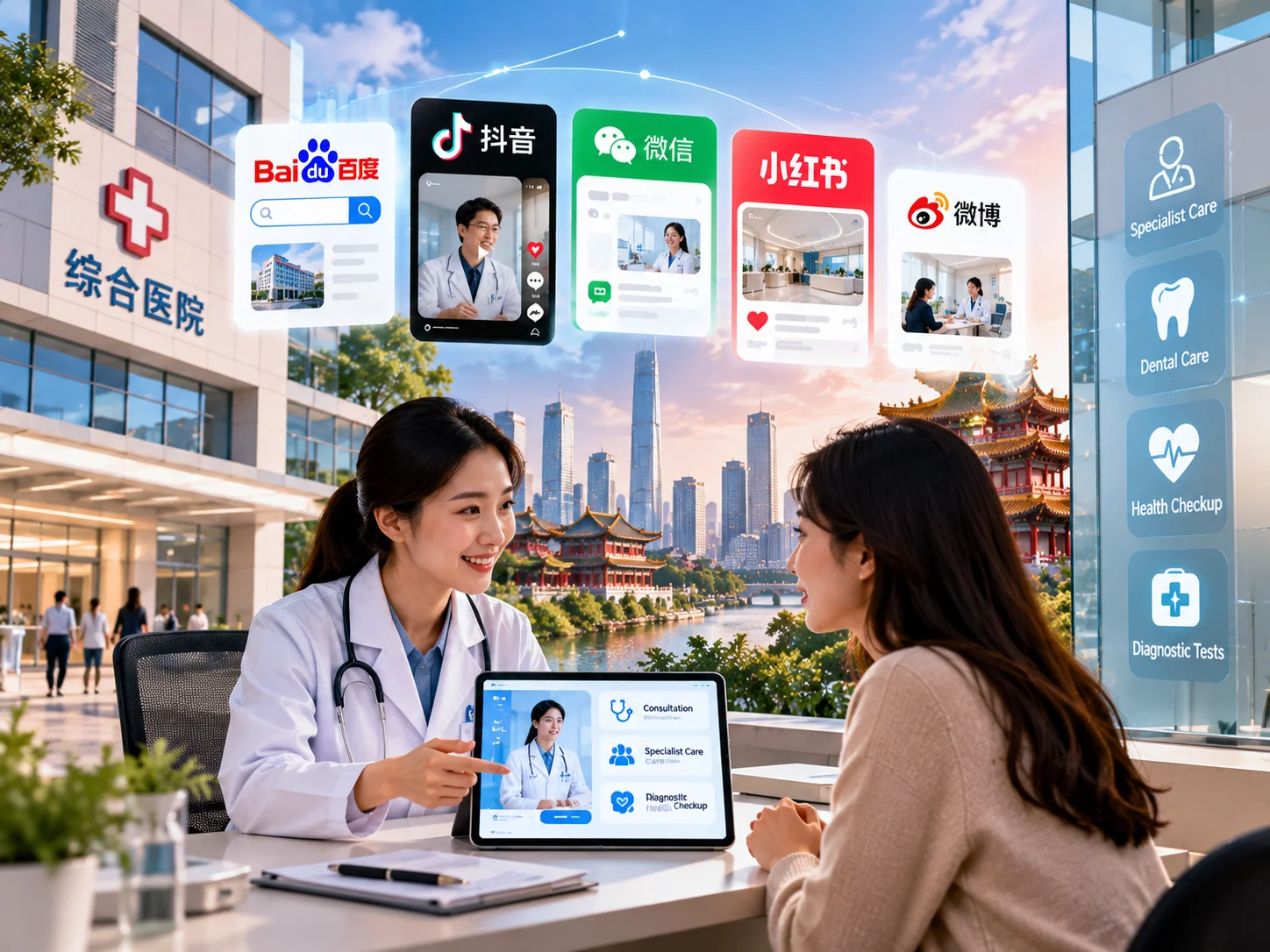
Patients rarely make healthcare decisions from one digital interaction. Before contacting a clinic, hospital, diagnostic centre or specialist, they often look for signs that the organisation is credible, accessible and relevant to their needs. In China, that process happens across local search engines, social platforms and mobile-first digital channels.
For Healthcare & Medical Businesses, a website alone is not enough. Potential patients may search on Baidu, check social content, compare providers and look for consistent information before making an enquiry. A strong online presence therefore needs to connect search visibility, useful content, localised communication, paid media and a clear patient journey.
China’s digital ecosystem differs from many Western markets. Platforms such as Baidu, WeChat, Weibo, Douyin and Xiaohongshu shape how people search and engage with brands. GUANGZHOU XIYOU DIGITAL SERVICES CO. LTD describes its China-focused approach around local platforms, Chinese-language localisation, search visibility, social presence, paid campaigns and digital compliance support.
This guide explains how healthcare providers can use those channels to build confidence and create a clearer route from online research to patient enquiry.
Trust Starts Before a Patient Visits the Clinic
Healthcare decisions carry personal risk. Patients may worry about cost, treatment quality, privacy, pain, recovery time or whether the provider understands their condition. If the online experience creates uncertainty, they may leave.
Trust should be visible at every major touchpoint. The clinic name, location, contact details, service information and practitioner details should be consistent. Pages should explain services plainly, social profiles should stay current, and enquiry routes should be simple.
Trust also depends on restraint. Healthcare content should not pressure people into treatment. Clear explanations, realistic language and transparent service information usually support confidence better than aggressive claims.
For Healthcare & Medical Businesses, digital trust grows when the same professional identity appears across search results, website pages, social accounts and advertising.
Build a China-Focused Website That Answers Patient Questions
A healthcare website should help a visitor decide whether the provider is relevant to their situation.
Each important service needs a focused page. A dental clinic may separate implants, orthodontics, preventive care and emergency treatment instead of placing everything on one page. A specialist clinic may organise pages around conditions, consultations, tests and follow-up care.
Useful healthcare pages can explain:
- What the service is intended for
- What usually happens during an appointment
- Which professional or department provides the service
- What patients may need to prepare beforehand
- How to request an appointment
- Where the facility is located
The language should be understandable to a non-specialist. Explain medical terminology when it is necessary.
Website performance matters too. The client website highlights fast, responsive and mobile-friendly development as part of its China digital services. That is relevant in a mobile-first environment, where slow pages, unclear navigation or awkward forms can interrupt the patient journey.
Use Baidu SEO to Become Visible During High-Intent Searches
Search visibility is a strong foundation for patient acquisition because it reaches people while they are actively looking for information or services.
China requires a market-specific SEO approach. The client website notes that Baidu and other local search engines follow different ranking patterns, while technical factors, hosting considerations, language structure and local search intent also affect performance.
A healthcare SEO plan should start with the language patients actually use. Internal medical terminology may differ from the phrases ordinary people enter into search. Keyword research should therefore cover service terms and question-based searches.
These may include searches around symptoms, treatment types, specialist availability, clinic locations, appointment information, recovery questions and comparisons between care options.
Healthcare & Medical Businesses should build pages around genuine patient intent rather than creating many thin pages for minor keyword variations. Useful, focused pages are easier for patients to understand and easier for teams to keep accurate.
Improve Local Search Signals for Clinics and Medical Facilities
Location matters when the service requires an in-person visit.
The website should clearly display the organisation’s name, address and phone details, and those details should stay consistent wherever the business appears online. The client’s local SEO material highlights NAP consistency, Baidu search visibility, Baidu Maps, local landing pages, directory management and review support as elements of local search work.
For a healthcare group with several branches, each location can have a dedicated page with accurate contact details, available departments and directions. Avoid duplicating the same generic copy across every branch page. Each location should provide information useful to people visiting that facility.
Make Healthcare Marketing Educational Before Making It Promotional
Strong healthcare marketing should reduce uncertainty rather than repeat service claims.
A useful content plan can answer the questions patients ask before they are comfortable speaking with a provider. Topics might cover how a consultation works, when someone should seek professional advice, what happens during a diagnostic process or how follow-up appointments work.
The objective is not to diagnose people through a blog or social post. It is to make the organisation and its services easier to understand.
Educational content also gives search engines and social platforms relevant material to surface. It can show depth around a service while supporting patients at different stages of research.
GUANGZHOU XIYOU DIGITAL SERVICES CO. LTD states that effective Chinese content requires more than translating material into Mandarin. Its content approach emphasises cultural context, platform behaviour, local customer journeys and content that feels natural to Chinese audiences.
That principle matters in healthcare. A literal translation may be grammatically correct but still feel distant, technical or unsuitable for the platform where it appears.
Build Social Proof Without Making Unsupported Claims
People often look for signals that other patients recognise and trust a healthcare provider. Reviews, patient feedback and reputation content can support that process, but they should be handled carefully.
A healthcare business should avoid turning social proof into exaggerated promises. Testimonials should not imply that every patient will receive the same outcome. Treatment claims and promotional language should also be reviewed carefully for accuracy and suitability.
Dependable trust signals include practitioner profiles, facility information, educational videos, FAQs, published expertise, consistent service details and genuine review management.
Social accounts should also remain active enough to show that the organisation is operating and communicating. Outdated profiles can make patients question whether the information is still current.
Use WeChat, Douyin, Weibo and Xiaohongshu for Different Patient Behaviours
Not every platform should carry the same content.
The client website identifies WeChat, Weibo, Douyin and Xiaohongshu as important channels for establishing a local social presence in China. It also describes Chinese consumers as mobile-first, socially influenced and trust-driven.
A healthcare provider should adapt content by platform instead of posting identical material everywhere.
WeChat can support longer educational communication and account updates. Short-form video channels can make complex subjects easier to understand through simple visual explanations. Lifestyle-oriented platforms may suit educational topics connected with preventive care, aesthetics, wellness or patient experience, provided the information remains responsible and accurate.
The tone may change between platforms, but the medical information, service details and brand identity should remain consistent.
Combine Organic Visibility With Carefully Managed Paid Campaigns
SEO and content take time to build. Paid media can support faster visibility for priority services, new locations or specific campaigns.
The client website lists PPC activity across search and social channels and describes campaign work around keyword research, audience targeting, conversion tracking, optimisation and performance reporting.
For healthcare marketing, paid campaigns should begin with a defined objective. A campaign intended to generate appointment requests should not be measured only by clicks. The landing page, form, phone enquiry process and follow-up response all affect whether paid traffic becomes a qualified enquiry.
Separate campaign groups by service, location or search intent so performance is easier to assess and visitors reach a relevant page.
Healthcare advertisements should also use careful wording. Trust can be damaged if an ad makes a claim the landing page cannot support.
Create Landing Pages That Reduce Friction
A paid ad or organic result may bring the right visitor to the website, but the landing page still has to earn the enquiry.
A strong healthcare landing page should make the next step obvious. The user should understand what the service covers, where it is available and how to contact the provider without searching through several menus.
Useful elements include a concise service explanation, location details, practitioner information, appointment questions and a clear enquiry route.
Avoid crowding the page with too many calls to action. If the main goal is appointment generation, keep the page centred on that action.
Forms should request only information genuinely needed at the enquiry stage. Long forms can make people hesitate, particularly before they have spoken with the provider.
Localise the Patient Journey, Not Just the Website Copy
Translation is only one part of localisation.
A China-focused patient journey also needs local search behaviour, familiar platforms, mobile usability, suitable content formats and culturally natural communication. The client website describes localisation across language, tone, visuals, platforms and timing rather than treating it as a direct language conversion.
Healthcare & Medical Businesses entering China should review every step from the first search to the appointment request. A visitor may find the organisation through Baidu, move to a social account, return to the website and then make contact. If each step feels disconnected, trust can weaken.
The brand name, service descriptions and contact details should remain aligned. Patients should not need to work out whether two profiles belong to the same provider.
Treat Digital Compliance as Part of Trust
Healthcare businesses cannot separate marketing from responsibility.
The client website notes that operating in China can involve regulatory requirements, ICP licensing, hosting considerations and broader digital compliance needs. It also offers support around those areas.
The practical lesson is simple: marketing teams should not publish first and review later. Website claims, campaign language, account setup, hosting decisions and promotional content should pass through the appropriate internal or specialist review process before launch.
That is especially important when content discusses treatments, outcomes or patient-sensitive subjects. Clear approval processes help reduce avoidable errors and keep public information consistent.
Measure Patient Acquisition Beyond Traffic
Traffic alone does not show whether a digital strategy is working.
A healthcare business should connect marketing activity with actions that matter. Useful indicators may include appointment requests, calls, qualified enquiries, consultation bookings, form completion rates, landing-page conversion rates and cost per qualified enquiry.
Search rankings and social engagement still matter, but they are supporting indicators rather than the final business result.
The client website emphasises campaign tracking, reporting, conversion measurement and ongoing optimisation across digital activity.
If traffic is rising but enquiries are flat, the issue may sit on the landing page, in the form or in the follow-up process.
Build a Connected Healthcare Marketing System
The strongest healthcare marketing programmes do not treat SEO, social media, content and paid advertising as separate tasks.
Search can capture demand. Educational content answers patient questions. Social channels support familiarity, paid campaigns increase priority-service visibility, and local search helps nearby patients find the right facility. Conversion tracking shows which activities generate meaningful enquiries.
When these pieces support one another, the patient receives a more consistent experience.
GUANGZHOU XIYOU DIGITAL SERVICES CO. LTD positions its services across SEO, PPC, social media, content, web development, localisation, research and China-focused digital support. For healthcare providers, the value of an integrated approach is not simply having more channels. It is making every channel reinforce the same credible message and patient journey.
Common Mistakes That Reduce Online Trust
Publishing thin service pages gives patients too little information. Sending paid traffic to a generic homepage adds unnecessary steps. Using the same social post across every channel ignores how people use each platform. Inconsistent contact details make the business harder to verify. Poor translation can make professional information feel unreliable.
Another mistake is focusing only on promotion. If every post asks for an appointment but very few answer patient questions, the brand may feel commercial rather than helpful.
Healthcare & Medical Businesses should review their online presence from the patient’s perspective. Search the business name, check major service pages, test the enquiry process on mobile and compare information across platforms. Small inconsistencies are often easier to spot when the experience is reviewed as one journey.
FAQs
1.Why is digital trust so important for healthcare providers in China?
Patients may compare several providers before making contact. Consistent information, useful service pages, practitioner details and clear enquiry routes can reduce uncertainty.
2.Is Baidu SEO necessary for healthcare businesses targeting patients in China?
Baidu is an important search platform in China, so it should form part of the search strategy for organisations targeting local visibility. SEO should be adapted to Chinese-language search intent, local technical requirements and the way people research services.
3.How can healthcare marketing generate more qualified patient enquiries?
Healthcare marketing should connect high-intent search visibility with useful content, focused landing pages, localised social communication and simple appointment routes. Tracking should then identify which sources generate genuine enquiries rather than only visits or clicks.
4.Should a clinic use every Chinese social platform?
Not necessarily. It is better to focus on platforms that match the audience, service and available content resources. A smaller number of well-managed channels can be more useful than several inactive or repetitive accounts.
5.What kind of content helps a medical brand build credibility?
Clear service explanations, practitioner information, patient FAQs, educational articles, short videos, facility information and accurate local details can support credibility. Content should inform rather than make unsupported promises.
6.How often should a healthcare provider review digital performance?
Check performance regularly for changes in enquiry quality, conversion rates, search visibility and campaign efficiency. Paid activity usually needs closer monitoring, while SEO and content need a longer view.
Build Trust First, Then Make Patient Acquisition Easier
Getting more patients online in China starts with being easy to find, easy to understand and easy to trust.
A strong healthcare presence should connect Baidu visibility, useful Chinese-language content, active local social channels, mobile-friendly web pages, careful paid media and clear enquiry paths. It should also maintain accurate information and responsible messaging across every platform.
For Healthcare & Medical Businesses, the most sustainable approach is to treat digital activity as one patient journey rather than a collection of unrelated campaigns. When people can find reliable information, verify the provider and understand the next step without friction, marketing becomes more useful to both the organisation and the patient.