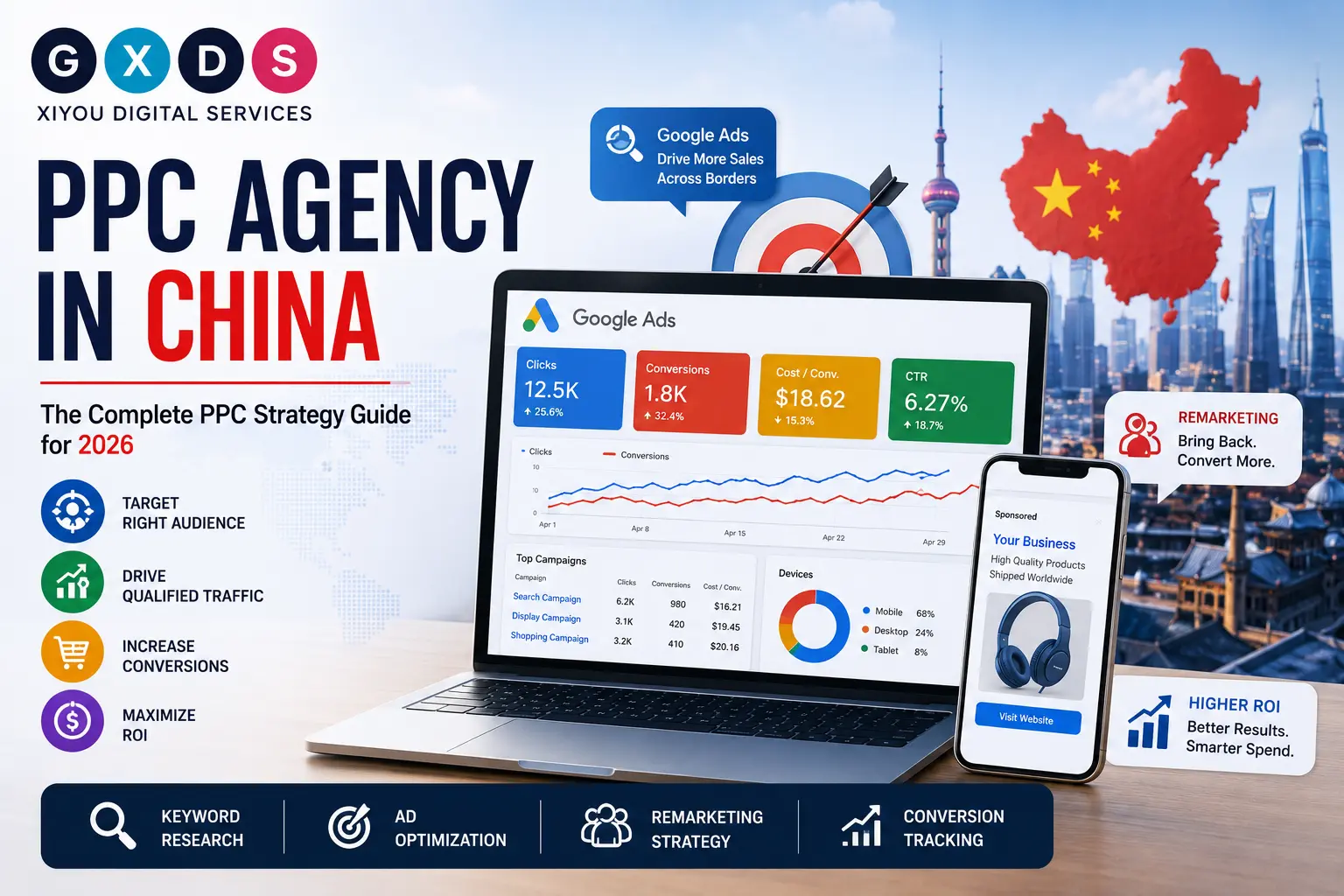
Every business competing for attention online eventually asks the same question: how do we get in front of the right customer, fast? For companies based in China that sell to overseas markets, the answer increasingly comes down to one channel — pay-per-click (PPC) advertising. Search and social platforms reward advertisers who understand the auction, the audience, and the offer, and that is exactly where a specialist PPC agency in China earns its value.
This guide breaks down what PPC is, how the ad auction works, and the specific strategies that are working in 2026 for cross-border sellers, manufacturers, and service brands that operate out of China but sell to the world.
What Is PPC Advertising and Why It Matters for China-Based Businesses
PPC (pay-per-click) is a model of online advertising where you pay only when someone actually clicks your ad, rather than paying simply for an ad to be displayed. For China-based exporters and service providers, PPC is often the fastest route into international markets — a well-run Google Ads or Bing Ads campaign can put a product in front of a buyer in the US, Europe, or Southeast Asia within hours of launch, long before organic search rankings would ever get there.
A properly optimized PPC campaign does two things at once: it drives immediate, measurable traffic, and it feeds data back into your wider marketing strategy — including the keyword and content decisions behind your SEO plan.
How the PPC Auction Actually Works
PPC runs on an auction. Advertisers bid on keywords, and when a shopper searches one of those terms, the platform decides which ads to show and in what order. That decision is not based on bid amount alone — it also factors in ad relevance and expected click-through rate (CTR), which is why a well-written, tightly targeted ad can outrank a bigger budget.
Ad position has a direct effect on CTR: ads shown near the top of the results page are seen — and clicked — far more often than those further down, which is why quality score and ad relevance matter just as much as your bid.
PPC Terms Every Advertiser Should Know
- CPC (cost-per-click) — what you pay each time your ad is clicked
- CPM (cost-per-mille) — cost for every 1,000 ad impressions
- CTR (click-through rate) — the percentage of viewers who click your ad
- Quality Score — a platform’s rating of your ad’s relevance and expected performance
- Ad Group — a set of closely related keywords and ads
- Negative Keywords — search terms you deliberately exclude your ads from
- Remarketing — showing ads to people who already visited your site
- Ad Extensions — extra details (phone number, sitelinks, location) added to an ad
Best PPC Advertising Platforms for Cross-Border Campaigns
Businesses exporting from China typically run PPC across three platforms, each with a different strength:
1. Google Ads
Google remains the largest search advertising network in the world and gives advertisers precise targeting by location, language, device, and buying intent — essential when your customer base sits outside mainland China.
A specialist Google Ads agency in China can set up geo-targeting, conversion tracking, and bidding strategy so that every dollar of spend is aimed at buyers who can actually purchase from you.
2. Bing Ads (Microsoft Advertising)
Bing Ads reaches a meaningfully different, often less-competitive audience than Google, with lower average CPCs and strong performance on desktop and B2B searches — a useful supplementary channel once your Google campaigns are stable.
3. Facebook and Instagram Ads
Meta’s platforms let you target by interest, behaviour, and lookalike audiences rather than search intent alone, which makes them ideal for brand discovery and remarketing to shoppers who have already engaged with your product.
Benefits of Running PPC Campaigns
- Cost-effective — you only pay for actual clicks, not impressions
- Fast results — traffic starts the moment a campaign goes live
- Fully measurable — every click, cost, and conversion is trackable
- Flexible — budgets, keywords, and targeting can be adjusted at any time
- Precise audience targeting by location, device, interest, and intent
- Builds brand recognition even among users who don’t click immediately
13 PPC Strategies That Will Drive Results in 2026
1. Understand Your Target Audience
Before writing a single ad, define who you are actually selling to — their location, buying stage, and the language they search in. Tools like Google Analytics reveal exactly who is landing on your site today, which is the fastest way to sharpen your targeting.
2. Advertise Across Multiple Platforms
Running campaigns across Google, Bing, Facebook, and YouTube widens your reach and, because you’re bidding on the same keywords in more than one auction, can actually lower your blended cost-per-click over time.
3. Use Negative Keywords
Negative keywords stop your ad from showing on irrelevant searches. A supplier of industrial parts, for example, would exclude terms like “jobs” or “free samples” to protect both budget and click-through rate.
4. Build Campaigns Around Relevant Keywords
PPC keyword research should never happen in isolation — it works best alongside your organic keyword strategy. Pairing paid campaigns with the work of an experienced SEO company in China means your highest-converting paid keywords can also guide your long-term content plan.
5. Add Ad Extensions
Sitelinks, call buttons, and location extensions give shoppers more reasons to click and more information before they do — both of which typically improve CTR at no extra cost.
6. Launch Remarketing Campaigns
Most visitors don’t convert on their first visit. Remarketing keeps your brand in front of them afterward, which consistently lowers cost-per-acquisition compared with cold traffic alone.
7. Build Mobile-Friendly Landing Pages
A great ad sending traffic to a slow or clunky landing page wastes every click you paid for. Working with a web development company in China to build fast, mobile-responsive landing pages is one of the highest-leverage fixes most advertisers overlook.
8. Try Lookalike and Similar Audiences
Once you have a base of existing customers, lookalike audiences on Facebook and Google let you find new prospects who share similar interests and behaviour — a reliable way to scale beyond your current audience.
9. Set a Realistic Budget
Decide what you can genuinely afford to spend before launch, track results weekly, and be willing to reallocate budget away from underperforming campaigns rather than letting them run on assumption.
10. Write Benefit-Driven Ad Copy
Ad copy converts better when it leads with the outcome for the buyer, not just a feature list — what problem does your product solve, and how quickly does the buyer feel that benefit?
11. Use Responsive Search and Display Ads
Responsive ads automatically test combinations of headlines and descriptions and adapt to the device they’re shown on, which generally improves CTR versus a single static ad variant.
12. Run Structured A/B Tests
Test one variable at a time — headline, image, or call-to-action — and let each test run long enough to reach a statistically meaningful result before acting on it.
13. Invest in Video Advertising
Video consistently drives stronger recall than text or static image ads. YouTube promotion in particular is becoming a core part of PPC strategy for China-based brands looking to build trust with overseas buyers before they ever land on your site.
Why Work With a Dedicated PPC Agency in China
Running PPC well takes ongoing management — bid adjustments, audience testing, and creative refreshes are not a one-time setup. Xiyou Digital Services works with China-based manufacturers, exporters, and service brands to plan, launch, and continuously optimize PPC campaigns alongside SEO, web development, and video promotion — so every part of your digital presence supports the same growth goal.
Conclusion
PPC remains one of the fastest, most measurable ways for China-based businesses to reach international buyers. The strategies above — audience definition, negative keywords, remarketing, mobile-ready landing pages, and video — work together rather than in isolation, and a specialist PPC agency in China can help you sequence them correctly instead of guessing at what to try first.
Frequently Asked Questions
Q1. Will my target audience actually click on my ads?
When ads are well-targeted, relevant to the search, and paired with a clear offer, click-through rates are consistently strong — most PPC underperformance comes from poor targeting, not from a lack of buyer interest.
Q2. How much does a PPC campaign cost?
There is no fixed price. Cost depends on your industry, competition for your keywords, business goals, and whether you manage campaigns in-house or through an agency.
Q3. How do I write a strong ad copy?
- Reflect the searcher’s intent directly in the headline
- Include a concrete number or statistic where possible
- Lead with the buyer’s benefit, not just a feature
- Use a clean, keyword-relevant display URL
- Test multiple ad variations rather than relying on one
- Address the buyer’s likely objection up front
Q4. How should I budget my PPC campaigns?
Budget is shaped by three factors — your bid, your targeting settings, and your ad quality. Tighter, more competitive targeting raises cost, while a higher quality score can lower what you actually pay to hold a top position.