Ranking #1 on Google means almost nothing on Baidu. Different algorithms, different ranking signals, and an entirely different search ecosystem mean that strategies working for Google often fail in China.
Many foreign brands invest heavily in Google SEO before entering China, only to discover that Baidu rewards completely different factors. From hosting location and ICP registration to native-language content and platform-specific trust signals, Baidu requires its own optimization strategy.
This guide explains the biggest differences between Baidu SEO and Google SEO so your business can avoid common mistakes and build a successful China SEO strategy in 2026.
Why Your Google SEO Strategy Won’t Work on Baidu
Although both search engines aim to provide relevant search results, the way they evaluate websites is very different.
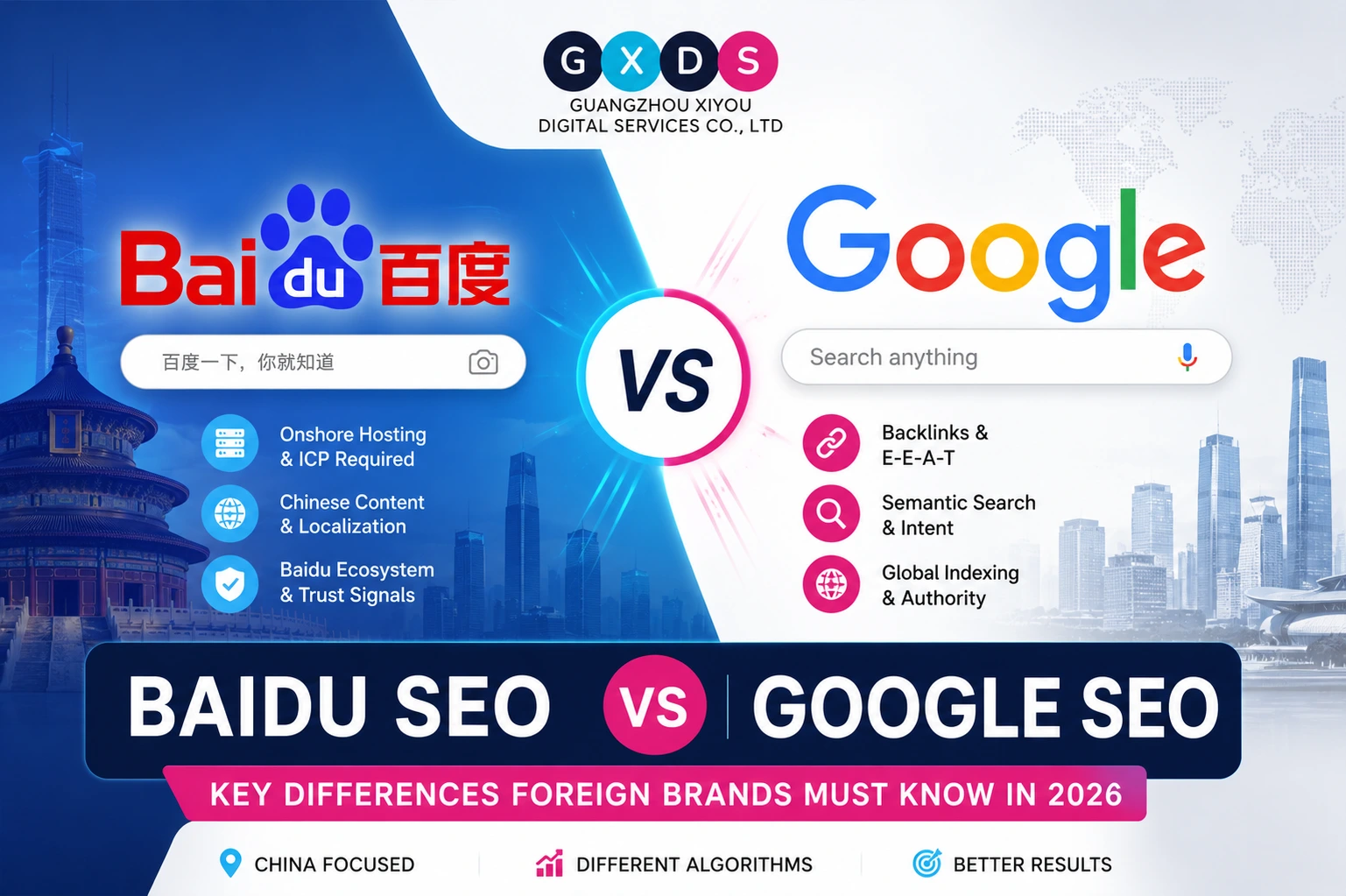
Google focuses heavily on E-E-A-T, backlink quality, topical authority, and search intent.
Baidu gives much greater importance to:
- Mainland China hosting
- ICP registration
- Chinese-language content
- Website freshness
- Baidu-owned platforms such as Baidu Baike and Baidu Zhidao
A website that performs exceptionally well on Google may struggle to appear in Baidu search results simply because it doesn’t meet these local requirements.
Market Share: How Dominant Is Baidu?
Baidu continues to be China’s largest search engine and remains the primary search platform for businesses targeting mainland Chinese users.
Although Bing has gained market share in recent years, Baidu still accounts for the largest percentage of searches across China. Google has almost no presence within mainland China because its services remain blocked.
For businesses entering China, Baidu should remain the foundation of every SEO strategy, while Bing can serve as an additional traffic source for desktop users and B2B audiences.
Ranking Factor Differences That Actually Matter
Several ranking factors have a much greater impact on Baidu compared to Google.
Baidu places greater emphasis on:
- Domain age
- Server location
- ICP registration
- Frequent content updates
- Exact keyword placement in titles and headings
- Chinese-language content
Google relies more on semantic search, user intent, backlink authority, and helpful content signals.
These differences mean that copying your Google SEO strategy rarely produces good Baidu rankings.
Hosting and ICP: The Ranking Factor Google Doesn’t Have
One of the biggest differences between Baidu and Google is hosting.
Websites hosted inside mainland China with an ICP registration usually load faster, are crawled more frequently, and receive greater trust from Baidu.
Websites hosted outside China often experience slower loading times because of network routing and internet restrictions, reducing their visibility in Baidu search results.
If your business plans to target Chinese customers seriously, obtaining an ICP registration and using local hosting should be a priority.
Content Language and Localization Rules
Translation alone is not enough.
Baidu favors content written specifically for Chinese audiences using natural Mandarin and local search behavior.
Successful localization includes:
- Native Chinese copywriting
- Local keywords
- Chinese cultural references
- Region-specific search intent
- Local user experience
Machine-translated pages rarely perform well because they often sound unnatural to both users and search engines.
Do Backlinks Matter on Baidu?
Yes.
However, Baidu evaluates backlinks differently from Google.
The most valuable backlinks typically come from:
- Chinese websites
- Government domains
- Educational institutions
- Industry directories
- Baidu platforms such as Baidu Baike
Generic international backlinks provide much less SEO value than they do on Google.
Mobile and App Ecosystem Differences
China is a mobile-first market.
Baidu integrates closely with its own ecosystem, including:
- Baidu App
- Baidu Mini Programs
- Baidu Baike
- Baidu Zhidao
- Baidu Maps
- Baidu News
Businesses active across these platforms often gain additional trust and visibility compared with websites relying only on traditional SEO.
Baidu SEO vs Google SEO
Instead of a comparison table, here’s a simple breakdown.
Google SEO
- Focuses on E-E-A-T
- Semantic keyword understanding
- High-quality backlinks
- Helpful content
- Global indexing
- English and multilingual optimization
Baidu SEO
- Requires ICP registration
- Rewards China-based hosting
- Prioritizes native Mandarin content
- Values exact keyword placement
- Prefers Chinese backlinks
- Integrates with Baidu’s ecosystem
Common Mistakes Foreign Brands Make
Many businesses fail because they assume Baidu works like Google.
The most common mistakes include:
- Hosting websites outside mainland China
- Publishing machine-translated content
- Ignoring ICP registration
- Skipping Baidu Webmaster Tools
- Not using Baidu Baike or Baidu Zhidao
- Building only international backlinks
- Forgetting China’s mobile-first audience
Avoiding these issues can dramatically improve your chances of ranking.
Building a Strategy That Works for Both
The most successful international brands don’t use one SEO strategy for every market.
Instead, they run two separate strategies.
For global markets:
- Google SEO
- International backlinks
- English content
- Global hosting
For China:
- Baidu SEO
- ICP registration
- China hosting
- Native Mandarin content
- Baidu ecosystem optimization
This dual approach delivers stronger long-term visibility across both markets.
Conclusion
Although Baidu and Google are both search engines, they reward very different ranking signals.
Success on Google doesn’t automatically translate into success in China.
Businesses looking to expand into the Chinese market should invest in ICP registration, local hosting, Chinese-language content, and a dedicated Baidu SEO strategy rather than relying solely on their existing Google SEO efforts.
A tailored China SEO strategy provides better visibility, stronger user trust, and greater long-term growth.
Frequently Asked Questions
1.Is Baidu SEO harder than Google SEO?
Not necessarily. It simply prioritizes different ranking factors such as local hosting, ICP registration, and native-language content.
2.Do I need a separate website for Baidu?
Not always, but businesses targeting mainland China usually benefit from an ICP-registered website hosted within China.
3.Does Baidu use backlinks?
Yes. Baidu values backlinks, especially those from trusted Chinese websites, government organizations, educational institutions, and Baidu-owned platforms.
4.Can Google Search Console help with Baidu SEO?
No. Baidu provides its own platform called Baidu Webmaster Tools for indexing, diagnostics, and performance monitoring.
5.Why isn’t my website ranking on Baidu?
Common reasons include offshore hosting, missing ICP registration, poor localization, or content that isn’t optimized for Chinese search behavior.
6.Should I optimize for Bing in China?
Yes. Bing has gained market share in China, particularly among desktop users and business audiences.
7.How long does Baidu SEO take?
Most businesses begin seeing measurable improvements within three to six months after implementing localized SEO, quality content, and technical optimization.