
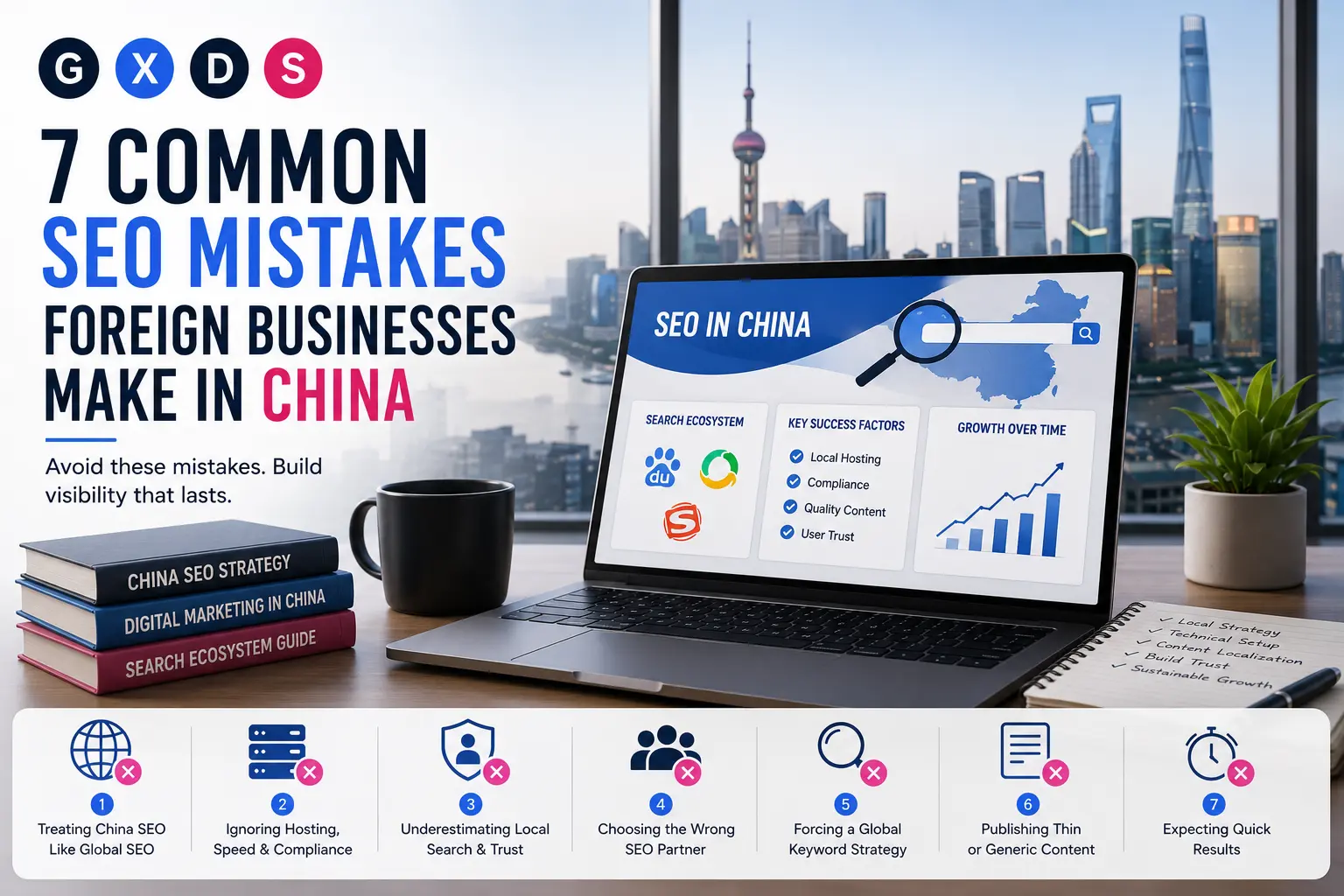
Most foreign businesses that struggle to rank in China make the same core mistake: they treat China SEO as a smaller version of Google SEO. China runs on its own search ecosystem, with different ranking signals, hosting rules, and user habits, so strategies built for the US or Europe rarely transfer as-is. Below are the mistakes we see international brands make most often, and what actually works instead.
Why Doesn’t China SEO Work Like SEO Elsewhere?
China’s dominant search engine weighs signals that most Western SEO teams never think about: page load speed from domestic servers, valid hosting registration, and content written natively for a Chinese audience rather than translated after the fact. According to the China Internet Network Information Center, the country now has well over a billion internet users, and roughly three-quarters of them use search engines regularly. The opportunity is real, but only for sites that are actually built for this environment from the start.
Mistake 1: Treating China SEO as an Extension of Global SEO
Reusing a Global Website Instead of Building for China
A common shortcut is translating the existing global website and hoping rankings follow. Direct translation misses local search intent, the phrases Chinese users actually type, and the cultural context that shapes what people trust. Local search engines also reward originality, so duplicated or machine-translated pages rarely earn authority, no matter how well the source content performs in English. Working with an SEO company in China that understands both languages solves this at the source.
Mistake 2: Ignoring Hosting, Speed and Compliance
Website speed inside mainland China depends heavily on where a site is hosted and whether it carries the correct registration. Offshore-hosted sites often load noticeably slower for mainland visitors, which damages both user experience and search performance at the same time.
Skipping the Required Website Registration
Many foreign companies discover late that hosting a site on mainland servers requires a formal government filing. Without it, pages load inconsistently, or the site gets blocked outright, undoing months of content investment. Our ICP license guide walks through exactly what’s required and how long the process takes. Pairing that filing with a properly built site from a web development company in China avoids a second round of rework later.
Mistake 3: Underestimating Local Search Behaviour and Trust
Ignoring the Platforms That Influence Search Trust
China’s search journey rarely begins and ends on one search engine. Consumers routinely cross-check brands on WeChat, Xiaohongshu, and Douyin before trusting a result, and increasingly, search visibility itself reflects that cross-platform presence. Brands that optimize only their website while ignoring social proof lose trust signals that local competitors are actively building. This is one reason KOC marketing has become such a strong complement to organic search work; authentic reviews build the same trust that search engines and shoppers both look for.
Mistake 4: Picking an SEO Partner Without Local Experience
Hiring a general international SEO team, or running strategy entirely from headquarters with no local execution, is one of the costliest mistakes foreign brands make. China’s search ecosystem shifts quickly, and effective strategy needs someone actively monitoring algorithm changes, compliance requirements, and platform behaviour on the ground. Knowing how to choose the best SEO company in China, and understanding the real difference between an SEO agency and an SEO company, both make this decision considerably easier.
Mistake 5: Forcing a Global Keyword Strategy Onto a Local Market
Keyword research built for English-speaking markets doesn’t map cleanly onto Chinese search behaviour. Search terms, question phrasing, and even the products people search for can differ significantly from one market to the next. Brands that skip local keyword research often end up optimizing for terms nobody in China actually searches, then wonder why traffic never arrives.
Mistake 6: Publishing Thin or Generic Content
Content that reads like a brochure, short pages with vague claims and no real depth, struggles to build authority anywhere, but the gap shows up faster in China, where results reward detailed, trustworthy content that fully answers a question. Brands that skip original research, data, or genuine expertise are easy for better-prepared competitors to outrank. As AI-powered answer engines increasingly summarise search results for users, this kind of substance matters even more, since thin pages rarely get cited as a source. SEO vs GEO for brands growing in China breaks down exactly what’s changed.
How Long Should You Expect Results to Take?
Realistic timelines matter here. Most foreign brands should expect early movement within three to six months, with meaningful authority building over a year or more, similar to competitive SEO markets elsewhere. Rushing the process with shortcuts such as buying links or stuffing keywords tends to trigger penalties rather than faster rankings. A steady approach, paired with Google Ads support to fill visibility gaps while organic rankings build, keeps growth on track without unnecessary risk.
Conclusion
China SEO rewards patience, local execution, and technical compliance over quick fixes. Avoiding these mistakes, treating China as its own market, fixing hosting and compliance early, building trust across platforms, researching keywords locally, and partnering with a team that understands the ecosystem, puts foreign brands on a far faster path to sustainable visibility. If you’re not sure where your current strategy stands, talk to our team for a straightforward review.
FAQs
Q1. Why isn’t my website ranking in China even though it ranks well on Google?
China’s search ecosystem uses different technical and trust signals, including hosting location, registration status, and native-language content, so a site built Google-first rarely performs the same way there.
Q2. Do I need a Chinese-language website to rank in China?
In practice, yes. A dedicated, natively written site hosted correctly for the region consistently outperforms a translated version of an existing global site.
Q3. Is a website registration required for SEO in China?
It depends on where you host. Onshore hosting requires formal registration, and unregistered sites often load poorly or get blocked, which hurts both rankings and user trust.
Q4. How long does SEO take to show results in China?
Most foreign brands see early movement within three to six months, with stronger authority building over a year, similar to other competitive SEO markets.
Q5. Can I run China SEO from my home country without a local team?
Research can start remotely, but ongoing execution benefits significantly from local monitoring, since platform rules and algorithm behaviour change quickly.
Q6. What’s the difference between an SEO agency and an SEO company in China?
The terms are often used interchangeably, but they can differ in scope and service model, so understanding the distinction helps you pick the right partner for your goals.
Q7. Does social media activity affect SEO performance in China?
Indirectly, yes. Search engines and shoppers both treat a consistent presence on WeChat, Xiaohongshu, and Douyin as a trust signal.
Q8. Should I run paid search while my organic SEO is still building?
Many brands do, since a well-run paid search campaign can fill the visibility gap while long-term organic rankings develop.